

I’ll start with a little bit about me. I love me a soda. Medical reasons limit me to diet, but I don’t complain. Prefer them in fact. Raised on them. They started as a weekend treat through my childhood, and now I dispose of an ungodly amount. They will be the death of me. I can’t stand the idea of wasting one of these glorious gifts of consumption. I need to mention this because after completing Astro Bot I am left with a large quantity of unfinished warm soda cans due to how this just game grabbed me from the start and just refused to let go.
In case you’re unaware of the recent phenomenon from PlayStation, Astro Bot is the latest entry from Team Asobi and their Astro Bot franchise. After first appearing in The Playroom (2013) this plucky droid became the new face for Sony hardware. Only appearing to show players what the latest hardware offering could do as a guide through the built-in software (excluding Astro Bot: Rescue Mission (2018) which released alongside the PSVR at a reduced price).
For years, I and many other players wondered if Astro really had the strength to be able to rise from tech demo specialist to Sony mascot savior behind the likes of Sackboy and Crash Bandicoot. But finally, In the year of our lord 2024, Astro Bot stands proudly without a subtitle in its own fully fledged (and priced) PS5 title.

The game starts where you left off in Astro’s Playroom (2020) safely flying through space with all your other little robot friends in your very own PS5 console spaceship. But suddenly,some big old Alien finds you, rips your ship apart and sends all your bots flying across the galaxy. Crash landing on an unknown desert planet, your mission is to recover all your little bot friends and ship parts from the hands of the alien and his own friends along the way. It’s pretty safe to say, if you’re looking for an engrossing story, this is not that game. The intro is there to frame what will be a collect-a-thon.
The marketing from this game put a huge emphasis on celebrating the history of PlayStation. With this, there was a risk of the game failing on implementing this effectively. It could have been a lazy game full of diary entries that do little more than to serve as a nostalgia riddled walking simulator. But a surprising aspect of this game that kept me coming back was how perfectly the game’s collectibles worked together to provide an addictive gameplay loop. Collectibles in this game are more than a glorified digital paperweight, they work as the integral progression mechanic.
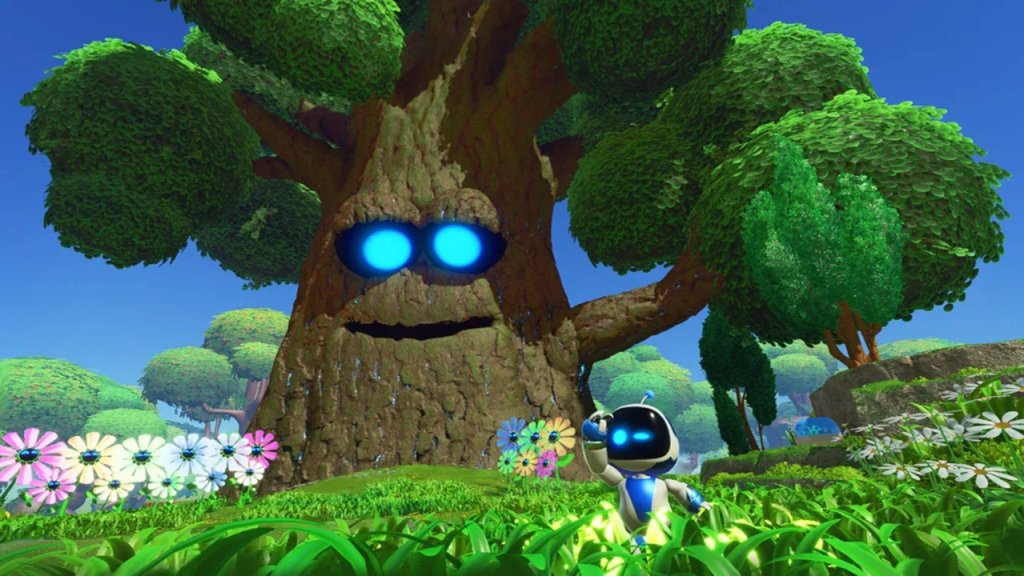
Puzzle pieces serve as keys to the cosmetic enhancement areas. Once you earn a certain amount, you unlock access to the gacha machine which lets you win iconic partner items for your astro bot mascots. As you earn more, you can unlock access to locations where you change your bots costume, spaceship decals and even a zoo to house the large array of animals you meet along your journey through the various galaxies.
The lost bots serve as the other main collectible. Many of these are made to resemble mascots from past PlayStation entries. As with the puzzle pieces, these also act as part of the main gameplay loop. To progress through the hub world, you need collect the defined number of bots so that they can help you scale different aspects of the crash site. Whether it’s chaining up to create a bot ladder or combining strength to help lift a large boulder, you need these little bots to succeed in this world.
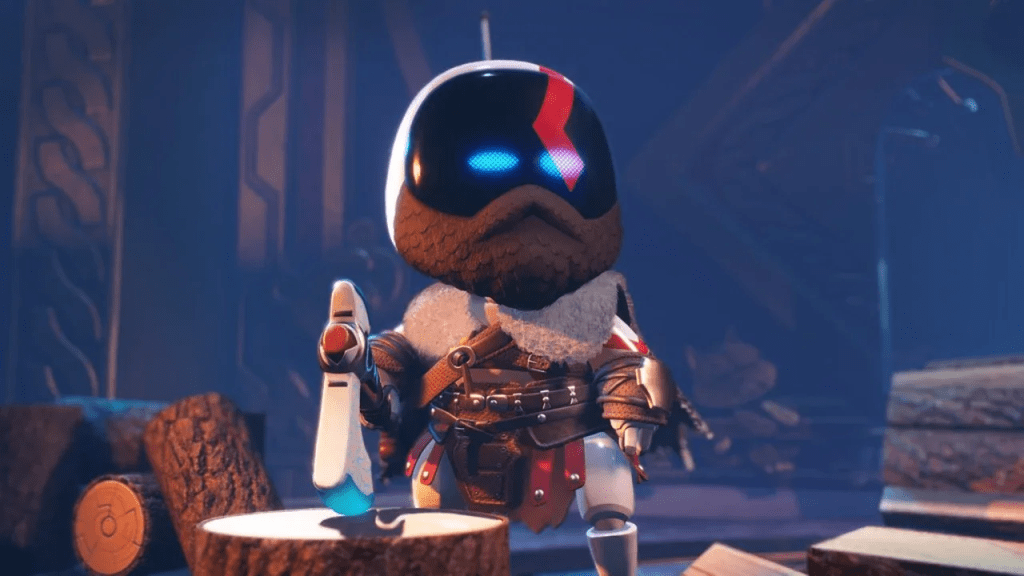
It never got old seeing PlayStation staples like Kratos or Aloy being trampled over as you move to the next area. When travelling through the levels, not only was I motivated by the number of bots, but seeing the love and care that was put into the little mascots and finding what new character was welcomed into the PlayStation alumni. There was an annoying smile I just couldn’t get rid of as I found another old friend hiding in a cavern off the beaten path.
Upon seeing them returned at the crash site, you can hit them to start an animation which usually served as an inside joke for whoever played their games. Every moment in this game left me with a somewhat unfamiliar feeling of wonder. A feeling that I’m sure I had once upon a time, perhaps when I last visited these lost heroes. And seeing them all come together to help in my journey through the Astro Bot universe kept me chasing that unfamiliar feeling all the way through, ensuring I always double backed to make sure I left no bot behind.
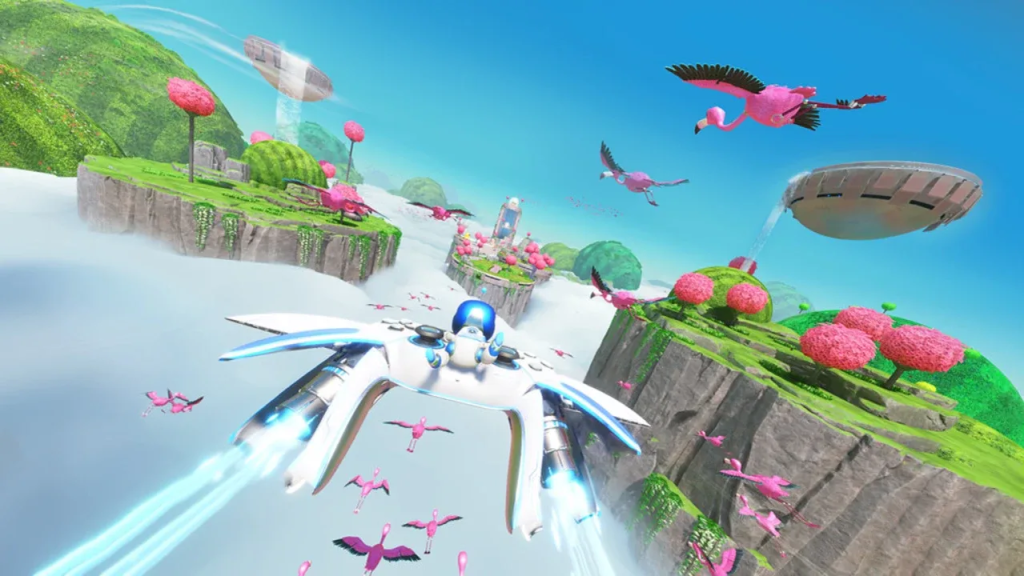
It wasn’t just the familiar bots that kept me invested. Seeing so many of these champions from my own gaming past made me wonder how these new characters with such high regard passed me by. So, if a mascot bot came along that I couldn’t quite place after reading the humorous non-descript synopsis, I found myself scrambling through the internet with any clues I had to sleuth out the answer like an underpaid millennial Sherlock Holmes with too much time on his hands.
Not a single collectible felt wasted, empty, or useless and that meant every single one I got pulled me deeper into the Astro Bot hole I felt in my life for twenty-two solid hours. This was, in no doubt, sustained by just how beautifully the gameplay worked.
Immediately, it was hard to find any real difference from what many players have experienced in their time in Astro’s Playroom, but that’s nothing to cry home about. Moving around is smooth like butter, and the most telling feeling of a good platformer is walking away feeling that it was never the game’s fault you fell to your demise. In all my time, I never experienced any bugs, any drops in frame rate, it just works.

Another way it immerses you into the game has been quite a divisive feature, but I would argue that this game absolutely nails the vision of the DualSense. Every step of astro’s little feet tippy tapping is registered through the controller through sound and vibration. Hovering over a gorge has extra weight to it as you feel the pushback of the hover jets through the haptics. Every defeated enemy is confirmed with a satisfying pop to confirm the kill. It felt like one layer of that fourth wall was being etched away as I navigated the world making me almost believe the little dudes on the other side of my screen genuinely existed there.
Again, reading the playbook from their previous iteration, Team Asobi keep the levels fresh by using items to bring creative mechanics in specific levels to provide new ways to scale that world, but this time, take it so much further. A few include a doggy booster pack to help you sprint through the air, a stopwatch to help slow down time, or a chicken (for some reason?) that can help you blast vertically. And with everything else in this game, they are crafted beautifully to offer a new experience with Astro. Like It Takes Two (2021) every new mechanic feels as good as the last, filled with genius ways to elevate the experience and test the player while ensuring they know exactly how to use these new abilities with little explanation. Each come and go without ever outstaying its welcome. I will have to keep a couple of these abilities close to my chest to avoid spoiling some. But trust me, they’re more than worth jumping into the game and checking them out because some of the absolute highlights of Astro Bot come in the form of these abilities.

If that doesn’t sway you, let me tell you this game left me feeling like I had finally witnessed the first truly next gen game on the PlayStation 5. Every frame in my journey through Astro Bot was just gorgeous. It wasn’t just the fidelity of everything on screen, but also the sheer quantity of items on the screen. There’s a total of 301 bots to collect in the game and they all come together to welcome you back home upon returning from travels in the galaxy with every one fully rendered and animated dancing and clapping your arrival.
Causing havoc in game leads to a mess of multicoloured confetti that exuded a childlike joy in me just watching the debris fly about. I nearly broke my brain for a better description of the feeling, but Peer Schneider (@PeerIGN on X) nailed it when he compares it to “running through leaves as a child”. It almost feels at time seeing a baby dressed up head to toe in the latest Louis Vuitton. A game like this should not be given this kind of power but am I glad it did. In some levels Team Asobi are straight up showing off with what they can do with this technology.
Astro Bot could have just been a curated love letter to PlayStation history, and honestly, I would’ve been happy with that. Especially considering the three-and-a-half-year development with a team of around 65 people. But what Team Asobi have achieved with this game astounds me at every opportunity.
It’s not just because it’s one of the best-looking games I’ve ever seen, or because I’m still walking around London humming every track in my head. It’s not because it’s given me some of the best level design this year, or because my belly ached from the laughter it provided. It’s because its all of the above and it was done with so much clear love and attention from the smallest detail to the largest bot.
Not only is this clearly a contender for the game of the year, but it rivals Mario at his sparkling best for the greatest platformer I have ever played and in doing so, cements its own legacy in the history books of Sony Interactive Entertainment.
Good: A platform game to rival some of the best in its genre, filled with smart collectibles that keep the player motivated to 100% every level.
Bad: Somewhat unimaginative boss designs and basic narrative (I had to write something here!)
10/10- Platforming excellence fuelled by admiration for the history of PlayStation that creates a modern gaming masterpiece.


 ScreenBunka
Leave a comment